
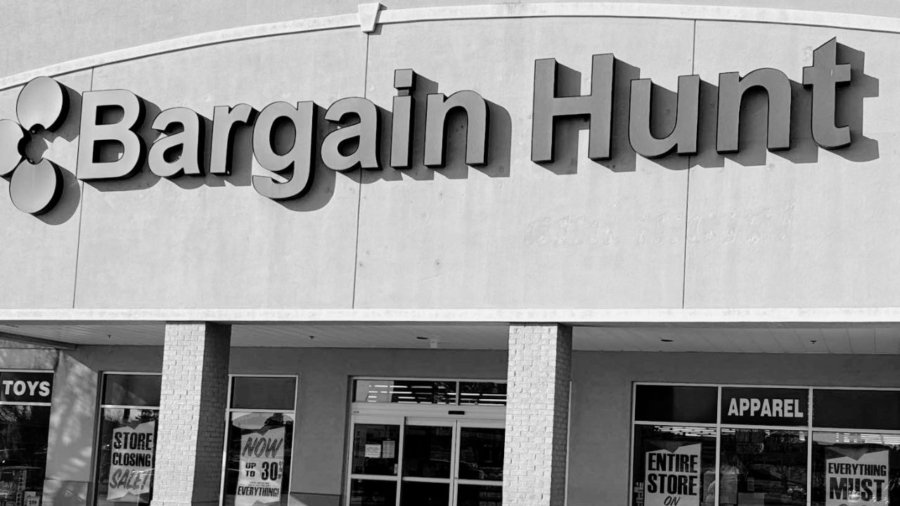
Shoppers who walked into their local Bargain Hunt in February 2025 did not find normal shelves. They found liquidation signs, discounted merchandise, and the reality that the chain was closing for good. This was not a rumor or a partial pullback. Every single store was shutting down permanently.
This article covers everything you need to know: the bankruptcy filing, the closure timeline, what happened to gift cards, why the business failed, and what comes next for the stores and the brand.
Yes, Bargain Hunt Is Permanently Closing All Its Stores
There is no softer way to put this. Bargain Hunt is gone. The parent company, Essex Technology Group LLC, filed for Chapter 11 bankruptcy on February 3, 2025, in the U.S. Bankruptcy Court for the Middle District of Tennessee.
This is not a restructuring. It is not a case of trimming weak locations while stronger ones survive. Every single one of the chain’s 92 stores across 10 states is closing. The states affected are Alabama, Arkansas, Georgia, Indiana, Kentucky, Mississippi, North Carolina, Ohio, South Carolina, and Tennessee.
As of March 2025, Bargain Hunt is listed as a defunct company. There is no reorganization plan, no partial survival, and no confirmed buyer for the brand.
The Bankruptcy Timeline and Store Closure Dates
The chain moved fast once the filing was made. Going-out-of-business sales launched almost immediately after the Chapter 11 filing on February 3, 2025. Most stores were expected to close by the end of February, with some sources indicating the liquidation could stretch into early March.
All 92 retail locations are closing, along with the distribution center in the Antioch/La Vergne area of Tennessee. That facility alone employed nearly 300 workers, and the broader closures affected hundreds more across the store network.
It is worth understanding what Chapter 11 actually means here. Normally, Chapter 11 is used by a company to reorganize its debts and keep operating. In Bargain Hunt’s case, it was used as a legal framework to wind everything down in an orderly way. Nothing was restructured or saved. The bankruptcy filing listed assets between $50 million and $100 million against liabilities between $100 million and $500 million — a significant gap that made recovery unlikely.
What Customers Needed to Know Before Stores Closed
If you shopped at Bargain Hunt or had a gift card, the window to act was very short.
Gift Cards
Bargain Hunt set a hard deadline of February 12, 2025 for redeeming gift card balances. After that date, cards were no longer accepted. If you had a $50 gift card and did not use it before that cutoff, it became worthless. That is less than two weeks from the bankruptcy filing to the gift card deadline — a clear example of how fast these situations move.
Going-Out-of-Business Sales
The liquidation sales were in-store only. There was no online equivalent during or after the wind-down. Discounts reached up to approximately 40% off the lowest ticketed prices. Merchandise included apparel, toys, home décor, lawn and garden products, automotive items, pet supplies, seasonal goods, and general overstock inventory.
Returns and Final Sale Policies
During liquidation sales, normal return and exchange policies are generally suspended. Bargain Hunt’s going-out-of-business sales followed this standard approach. If you bought something during the liquidation period, the expectation was that it was a final sale with no returns.
The broader lesson here applies to any retailer closure: when a company announces liquidation, act quickly on gift cards, assume all sales are final, and do not expect normal customer service levels to continue.
Why Bargain Hunt Failed
There is no single explanation. Several factors combined to make the business unsustainable.
Competition From Every Direction
Essex Technology Group cited competition from nearly every segment of retail — big-box stores, convenience retailers, and other discounters all targeted the same budget-conscious shoppers. Bargain Hunt was not just competing with one type of rival. It was being squeezed from all sides.
Chains like Dollar General, Ollie’s Bargain Outlet, and Walmart’s clearance sections all compete for the same customer. Add in Amazon and online discount platforms, and the pressure on a physical-only closeout retailer becomes intense.
The Closeout Model Got Harder
Bargain Hunt’s entire business model depended on sourcing overstock, excess inventory, and closeout merchandise at low prices and reselling it to shoppers at a discount. Founded in 2004, the chain built its identity around that treasure-hunt format — you never quite knew what you would find on the shelves.
The problem is that the supply of that type of inventory has changed. Major retailers and platforms have become much better at managing their own excess stock. Some sell it directly through their own clearance channels or online platforms. Others use their own liquidation networks. That leaves less high-quality overstock available for chains like Bargain Hunt to source profitably.
Inflation and Supply Chain Pressures
Ongoing inflation and supply chain disruptions made the model even harder to sustain. When your margins are already thin — because you are a discount retailer buying excess stock — rising costs hit harder than they would for a retailer with more pricing power.
Heavy Debt Load
The financial picture at the time of filing was stark: liabilities of $100 million to $500 million against assets of $50 million to $100 million. The company carried significant obligations to multiple creditors, including multi-million-dollar debts to Amazon. That level of debt, combined with margin pressure and increased competition, left very little room to recover.
What Happens to the Stores and the Brand
Hilco Consumer-Retail and Gordon Brothers are managing the liquidation process. That includes selling off merchandise during the going-out-of-business sales as well as handling the sale of store fixtures and equipment.
The store leases and the Tennessee distribution center are being auctioned. Other retailers may move into those physical spaces, but not under the Bargain Hunt name. There is no indication that any buyer has acquired the brand for a future relaunch.
For the communities that relied on these stores — particularly lower-income areas where closeout retailers fill a genuine budget-shopping need — the closure means turning to Dollar General, Ollie’s, Walmart clearance sections, or online discount options. None of those is a perfect substitute for what Bargain Hunt offered.
What This Tells Us About Discount Retail Right Now
Bargain Hunt is not an isolated case. It is part of a broader wave of retail financial stress in 2024 and 2025. Even deep-discount chains, which you might expect to thrive when consumers are stretched, are not immune to margin compression, e-commerce competition, and debt problems.
The closeout retail model specifically faces a structural challenge. As major retailers get smarter about inventory management, the volume and quality of available overstock shrinks. That is a long-term trend, not a temporary blip.
For entrepreneurs and business operators in retail, the Bargain Hunt story is a useful case study in how a business model that worked well in one environment can become unworkable when the supply dynamics, competition, and cost structure all shift at the same time. If you want more practical analysis on business decisions and strategy, KeyBusinessGoal covers these topics in plain terms.
The Bottom Line
Bargain Hunt is permanently closed. All 92 stores across 10 states shut down by March 2025 following a Chapter 11 bankruptcy filing by parent company Essex Technology Group on February 3, 2025. Gift cards expired on February 12, 2025. Going-out-of-business sales offered discounts up to about 40% off but were in-store only and are now over.
The closure came down to a combination of heavy debt, increased competition, inflation, supply chain issues, and a business model that became harder to sustain as the overstock market tightened. There is no planned revival, no buyer for the brand, and no online continuation. The chain is simply gone.
Also Read: